1st June, 2026
·
5 min read
Shetland Food Month
A version of this story first appeared in the Sunday, March 8th 2026 issue of The Sunday Post.
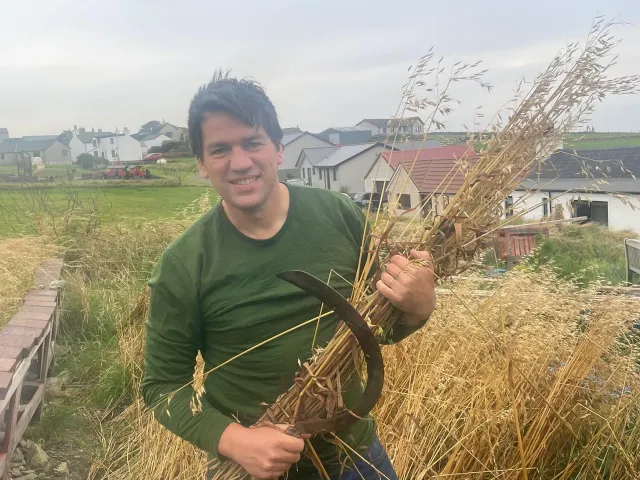
When Britain’s most northerly paediatrician decided to treat himself to a birthday cake, he had to start preparing five months early.
First, kneeling on the gravel of his garden, Alex Armitage thumbed oat seeds into the pebbly ground. Then he began sharpening his sickle. Come summer, and with his 44th birthday approaching, he took his harvest, dried the sheaves and began blending grains.
“I’d been sieving oats for three hours and finally had enough to make a birthday cake,” he recalls. As he slumped to admire his handiwork Alex thought of his wife on her way back from book club. “I was knackered. Then I saw a film of flour everywhere and realised she’d be really p****d off when she came in.”
This, he says, was the lowest moment of a self-prescribed challenge to spend a month eating only food grown or reared on the Shetland Islands. “As a busy person I’ve always felt food was such a functional thing,” he says. “I wanted to devote more of my life to what I eat: to have a personal connection to everything I put in my mouth.”
And — after battling caffeine withdrawal for the first three days, learning to churn his own butter and inventing possibly a new type of cheese — Armitage succeeded. Not only did the doctor create an oat-based Baked Alaska for his birthday, he lost weight and forged a more meaningful relationship with food.
“Some work colleagues were definitely nervous, but my physical and mental health were so much better during that month,” he says. “We have a food system that makes more money if it sells us refined carbohydrates and sugar. My Shetland food month was an act of resistance against that. For a time, corporations were not in my body.”
A Typical Daily Menu
Breakfast— Frozen herring fried in hand churned butter with leeks, onions and greenhouse tomatoes. Local sea salt. Mint tea.
Lunch—A microwaved potato with hand-churned butter, sea salt and back-garden parsley. Perhaps also a tomato.
Dinner—Pickled herring with beetroot and barley gnocchi. A treat: homemade ice cream made from local milk, buttercream and honey, or blackberries and rosehips with cream and honey.
This is what a Shetland food pyramid looks like in the month of September.
Protein was the easiest thing, says Alex, who also works as a local councillor. He was helped by the fact he loves herring and has a friend at the fish factory. Eggs and milk were easy to come by and another councillor donated a leg of lamb from her croft.
Carbohydrates were not hard to find, but were not very varied. Bread from the local bakery was out (it uses ingredients from the mainland) but, Alex learned, you can cook a potato almost as many ways as you can cook an egg. This was bolstered by barley flour from a nearby farm and his own backyard oats — flour from both of which Alex rustled into breads, cakes and occasional gnocchi. Without sugar he turned to a £40, one-litre tub of local honey.
Fat might have been easy if Alex was prepared to quietly bend the rules. All oils were out, but Shetland Dairy does a lively trade in butter from local cows. Only once the challenge had begun, however, did he learn that their butter uses salt from the mainland.
“It was a bit spur of the moment: I needed to fry some stuff and suddenly realised I didn’t have anything to fry it in,” he says. Later that day he set about churning his own.

Fruit and vegetables were, Alex concedes, “really difficult”. Little of the produce you’d recognise in a supermarket grows out doors in windy, treeless Shetland — blackberries, root vegetables and kale are the exception. But Shetlanders today have a crucial new tool in their gardening belt: the Polycrub.
Polycrubs are industrial strength greenhouses designed in Shetland to protect gardens from the worst of the North Sea’s wind. “I guess the Polycrub is a part of our culture now,” says Alex.
The plastic tunnels, often bolstered by recycling fish farming pens, bore soft fruits, tomatoes and a world of salad veg. Still, no hope of bananas, avocados or any citrus fruits. Another secret weapon in Alex’s arsenal was Jenny Watt, a food scientist and foraging enthusiast.
“People think of Shetland as this bleak, wintery place but if you start to forage you realise that everything has its little season,” she says. “There’s plenty of edible food in Shetland, if people are willing to eat it.”
Jenny put Alex onto sea sandwort growing between rocks along the coast (“It tastes like cucumber and is helluva good when pickled,” she says) and helped ferment plums, honey and herbs into a fizzy soft drink. Together they attempted a “not exactly drinkable” beer (Shetland has a brewery, but gets its hops from the mainland), and Jenny was able to chip in some more exotic spices from her own Polycrub, including Szechuan peppercorns.
Was she tempted to join in the challenge? “Absolutely not; I really love globalism. I could never give up the coffee.”
Alex admits that taking himself off caffeine left him with head aches for the first three days. He calmed this urge with roasted dandelion root tea, which apparently tastes similar.
Along the way he was buffeted with gifts from across the isles: strawberries from Yell, plums from a Fair Isle Polycrub and, once, a crate of live lobsters flown over from the distant island of Foula.
He also got creative himself. Craving cheese, he curdled hot milk with acidic rhubarb juice. This “rhubarb ricotta” he boiled down to a kind of Brunost, Norwegian cooked cheese. Alex promises this tasted much better than it sounds. His family could not be tempted to join the challenge.
Between the gifts, home-bakes and inventions, he found he wasn’t missing one particular food as much as the convenience of a quick, grabbable snack. In its place, however, he found “an informal food economy” connecting the islands.“Everyone’s growing stuff and sharing it,” he says. “This was a way of experiencing what people always used to: the pleasure of producing, sharing and eating food in a community.”
As we finish talking he points over to a parcel on his living room table, wrapped in blue bow. Oat seeds for this September have just arrived.